Public Space Initiative Takes on a Life of Its Own
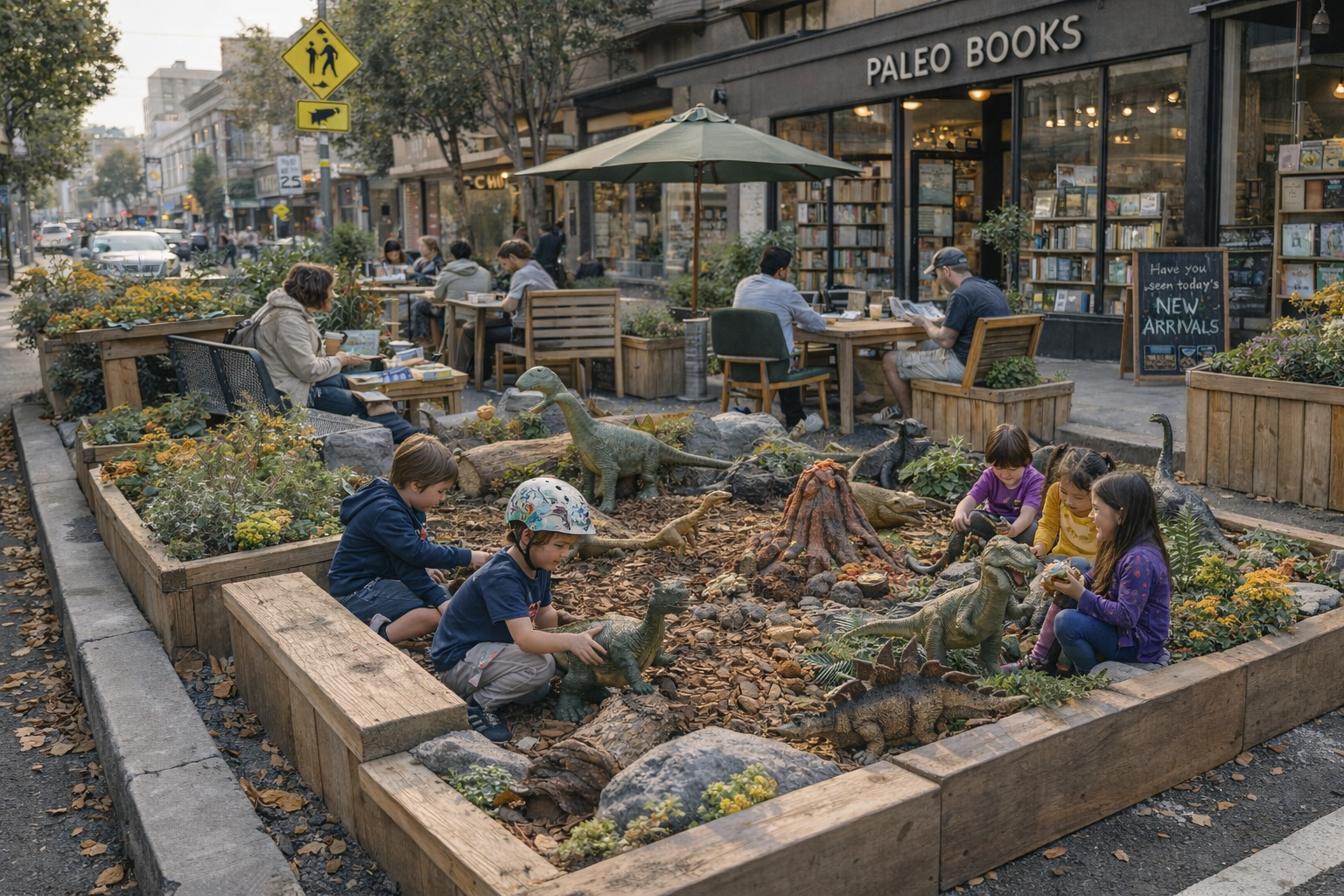
Originally conceived as a small outdoor extension of Paleo Books, the parklet has evolved into a highly utilized public space. Adjustments have been made in response to usage patterns, including the introduction of additional play features and a noticeable increase in dinosaur activity.
Looking at the success his neighboring restaurants were having with outdoor dining, Alan Hammond had an idea for his bookstore on Nublar Avenue.
Paleo Books had been an anchor downtown for years, a gathering place for families who would spend hours in the children’s section and play area.
“I noticed some of my slower days were when the weather was really nice,” Hammond said. “People wanted to be outside. And I saw the city had a ‘streeteries’ program… so I thought—why not the bookstore?”
It began as a modest but charming installation in a single parking space in front of the shop.
There were benches of varying sizes. A few rotating bookshelves. And at the center, a small dinosaur play area—half a dozen plastic figures set within a carefully constructed prehistoric landscape.
The scene was designed and built by local artist and Hammond’s husband, John Grant, intended as an immersive environment for children.
The dinosaur theme was inspired by Grant’s niece, Josie, who, like many three-year-olds, has a deep and unwavering interest in dinosaurs.
The installation was an immediate success.
Children enjoying playing in the street.
As use increased, the play area expanded to occupy more of the parklet. Seating was reduced to accommodate demand. For a time, this arrangement held.
Eventually, however, parents began gathering along the sidewalk edge, pulling chairs from nearby businesses, and informally extending the footprint of the space.
A second parking space was incorporated.
Then a third.
“We didn’t fully consider long-term containment,” said Assistant City Manager Ellie Sattler, who oversees the city’s public right-of-way program. “At the time, it was working.”
The installation continued to grow.
Additional dinosaurs were introduced. The landscape became more complex. Boundary conditions became less defined.
Today, the play area occupies every available on-street parking space along the 700 block of Nublar Avenue, with discussions underway regarding a potential expansion into a nearby vacant lot.
Not all stakeholders are supportive.
“Look, we love the dinosaurs,” said Ian Malcolm, who runs a barber shop across the street. “But the loss of parking on a commercial corridor like this—it’s significant.”
He paused.
“Also… there are just a lot more dinosaurs than there used to be.”
Despite concerns, the city council faces a difficult decision.
No one is eager to reverse a project that has become deeply embedded in the daily life of the neighborhood.
Site plan for Nublar Bookstore Sidewalk Extension Program
The space is now commonly referred to as Jurassic Parklet.
Even Hammond acknowledges the situation has evolved beyond its original scope.
“When we started, we knew it was possible,” he said. “We just… didn’t spend much time thinking beyond that.”
Case Study: The Emerald Valley Pedestrian Corridor
The dramatic backstory to building one of the worlds most celebrated (and sung) pedestrian corridor.
Case Study: The Emerald Valley Pedestrian Corridor
An in-depth look at a regional infrastructure project that became a cultural phenomenon.
Introduction
Celebrated alongside iconic pedestrian routes like New York’s High Line, Atlanta’s BeltLine, and Chicago’s 606, the Emerald Valley Pedestrian Corridor has become one of the region’s most beloved and traversed pathways. More than a simple connection between rural settlements and the Capitol District, it has served for generations as a rite of passage, a scenic journey through distinctive landscapes, and—according to some travelers—an unexpectedly introspective experience.
This case study looks behind the curtain at the planning, public input, and construction process behind one of the most unusual public-sector projects ever undertaken in Emerald County.
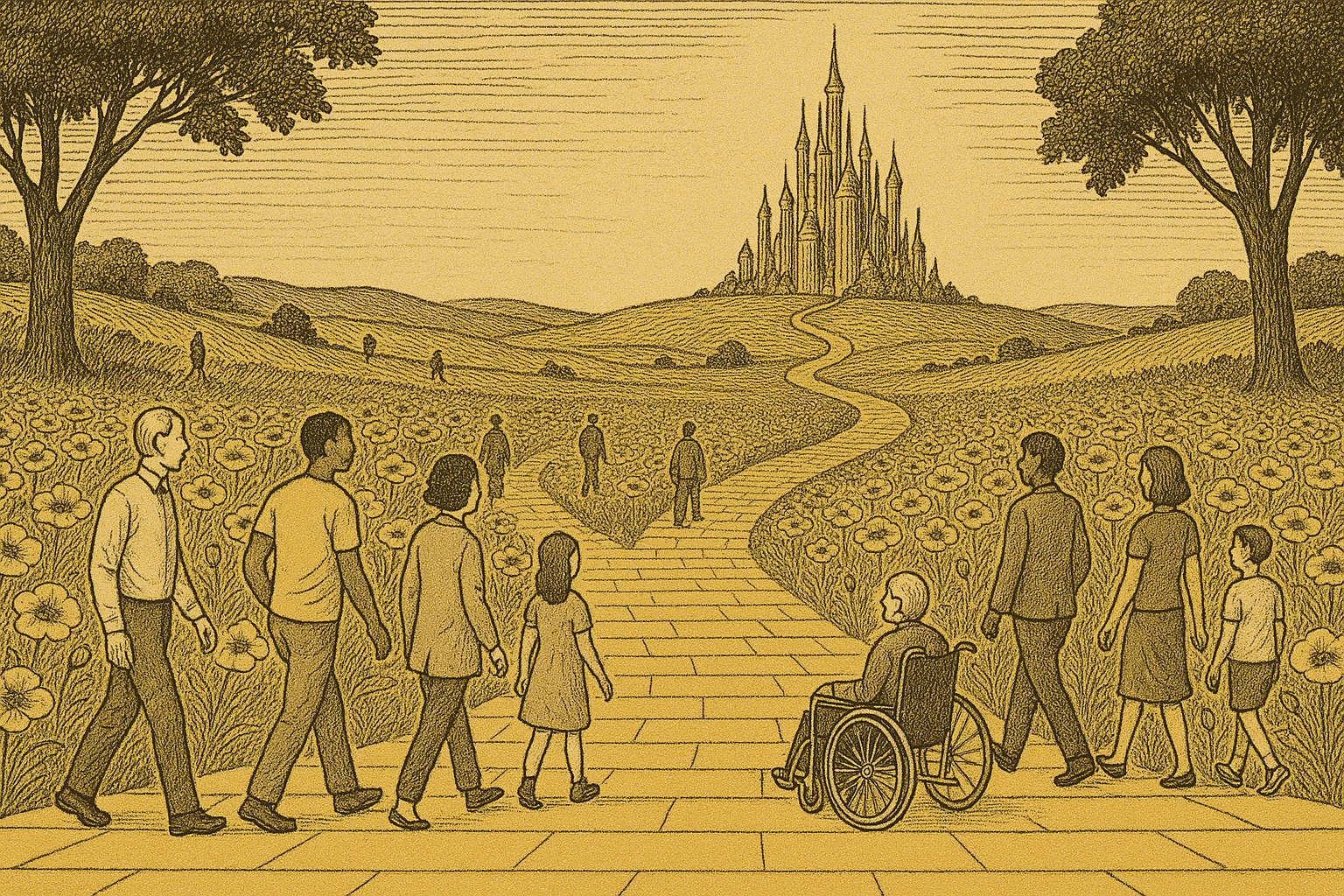
Original artist rendering of project concept
Project Purpose & Goals
The Emerald Valley Corridor was conceived to address a persistent need: establishing a safe, intuitive, all-ages pedestrian route through a complex and often unpredictable environment that includes agricultural fields, dense forest, floral lowlands, and regional peculiarities such as intermittent airborne wildlife.
Primary goals included:
Creating a continuous, legible pedestrian link between rural communities and the Capitol District
Improving wayfinding in areas with frequent forks, looping paths, and narrative ambiguity
Enhancing traveler safety during sudden weather events
Incorporating a visible, morale-boosting surface treatment compatible with regional brand guidlines
Public Input Process
Scoping Session
Public enthusiasm for improved pedestrian infrastructure was high, though residents proposed an unusually broad range of surface materials—including cobblestone, blacktop, holographic LED panels simulating water, and premium synthetic turf “for a more inviting texture.”
Brick was ultimately selected due to durability and the vendor’s availability of a highly reflective yellow variety described in procurement documents as “uplifting in tone.”
One resident from the western outskirts expressed concern that the corridor might encourage “storm-displaced migration”—interpreted as a veiled reference to unhoused residents. The comment was recorded without additional staff response.
Design Workshop
Notable contributions included:
Navigation: A rural resident, identified as S. Krowe, emphasized the need for intuitive wayfinding, saying, “A traveler shouldn’t need an advanced degree to know which direction they’re meant to go.”
Infrastructure: A representative from the Sheet Metal Workers Guild proposed the addition of filling stations along the route—a suggestion that prompted follow-up questions, as the corridor is pedestrian-only and no clear explanation was provided regarding what, precisely, would be filled.
Acoustics: A resident from the northern forest subdivision grew visibly emotional when discussing noise sensitivity and asked the design team to minimize sudden or startling sounds along the corridor.
One of 14 design charettes.
Environmental Review
Color selection emerged as the most contested element of the environmental review.
Green Proposal: The mayor of the municipality locally known as M-Ville supported a green surface as “a nod to the Irish heritage of many of our residents.” This proposal received polite applause before being immediately challenged by the Regional Bicycle Coalition.
Bicycle Coalition Objection: Coalition representatives strongly opposed green pavement, calling it “a misleading suggestion of bicycle integration, particularly given that not even the slightest pretense of effort whatsoever has been made to connect this corridor to the existing bike network.”
Red Proposal: Red, which aligned closely with the Flower District’s brand guidelines, was vetoed by Fire Services under “Section 513-64(a)(17)” of the Emerald County Fire Code. Upon further investigation, it was revealed that the cited code simply says, “Because I’m the Fire Chief.” No further discussion ensued.
Orange Proposal: Orange was unanimously rejected by multiple attendees; no rationale was provided.
CEQA Complaints: One participant filed 47 CEQA-style objections. Legal counsel reviewed them and concluded they “wouldn’t hold water,” a determination that appeared to offend the complainant for reasons staff could not determine.
Planning review board takes public comment.
Construction Notes
Construction proceeded with several notable challenges:
Weather: Multiple delays occurred due to cyclonic activity in agricultural areas.
Color Accuracy: Contractors disputed the precise definition of “Technicolor yellow” referenced in design specifications.
Burial Site Concern: Work temporarily halted when crews believed they had uncovered a burial site; further investigation determined the material to be only a pair of striped socks lodged beneath storm debris.
Budget Summary
Initial Budget: 1.4 million
Final Cost: 2.777 million
Cost overruns were attributed to:
Advanced chromatic brick treatments
Floral-lowland mitigation measures
Storm-damage cleanup
Late-phase “narrative resonance testing” requested during community review
Wildlife-mitigation requirements involving intermittently airborne species
Post-Launch Reception
Since opening, the Emerald Valley Corridor has become a defining regional amenity. Travelers describe it as:
“Uplifting”
“Surprisingly easy to follow”
“More meaningful the farther you go”
Several users report experiencing “clarity,” “renewed confidence,” or “a stronger sense of home.” While not specifically listed among the project’s performance indicators, these outcomes have been recognized as positive ancillary benefits.
Key Takeaway
Planners don’t give communities their care, their creativity, or their sense of belonging; the best they can do is help reveal what was already there.