
Disassembling Maslow’s Pyramid
If you work in the Urban Place District Management world, you have likely seen some version of Maslow’s Hierarchy of Needs adapted to reflect the needs of a district — with Clean and Safe as the foundation upon which the desired layers of marketing, activation, economic development, and advocacy rest — and rely.
If we are considering this pyramid as a way to prioritize outcomes, it is spot on. I’ve said it before, and it’s worth repeating — it don’t mean a thing, if it ain’t got that clean. If your neighborhood is not operating from a baseline of cleanliness and a general feeling of public safety, the rest of it isn’t going to matter all that much.
However — and this is important — we need to be clear about what the pyramid is actually describing.
It is a hierarchy of desired outcomes.
It does not prescribe a priority of effort.
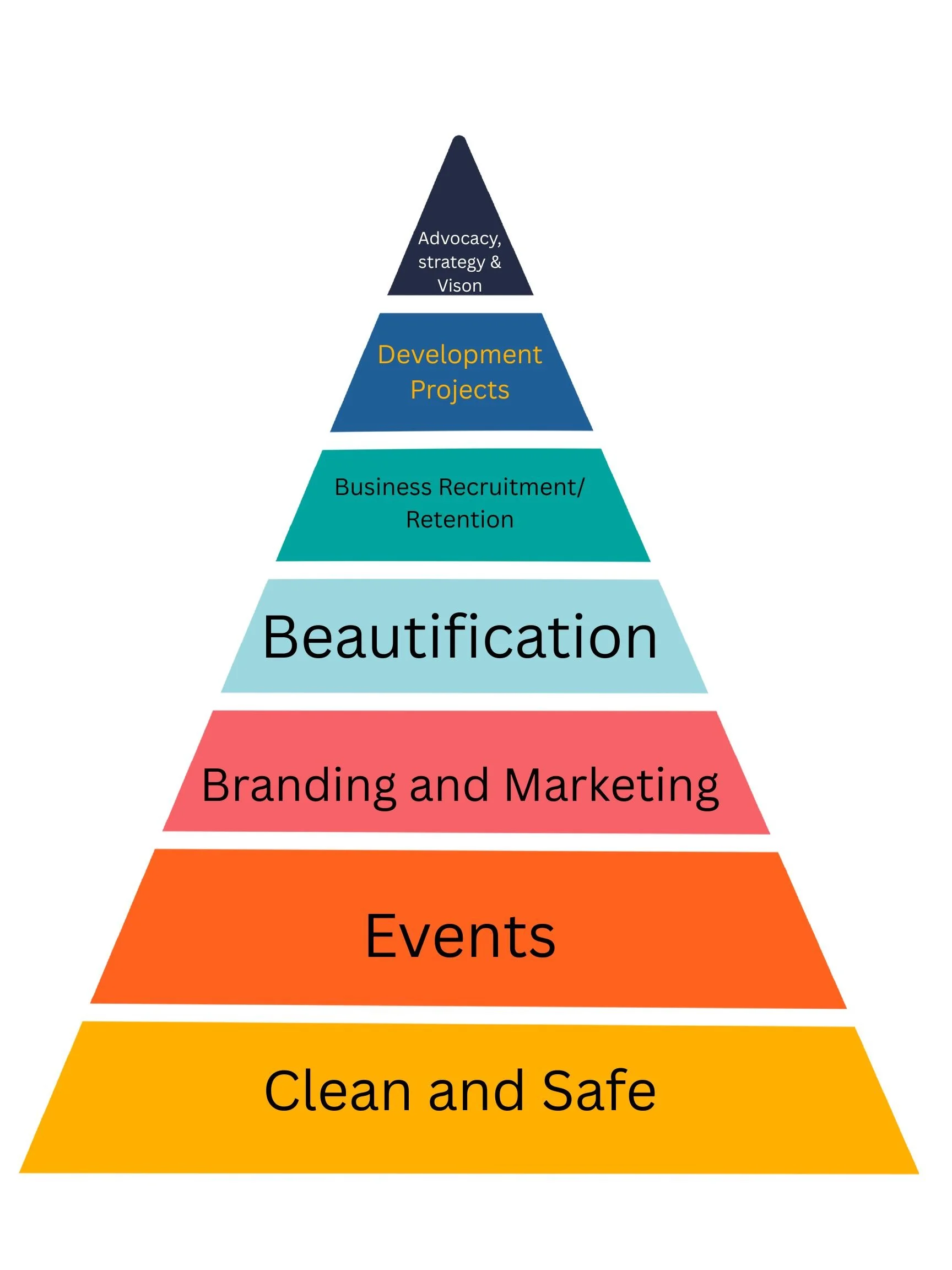
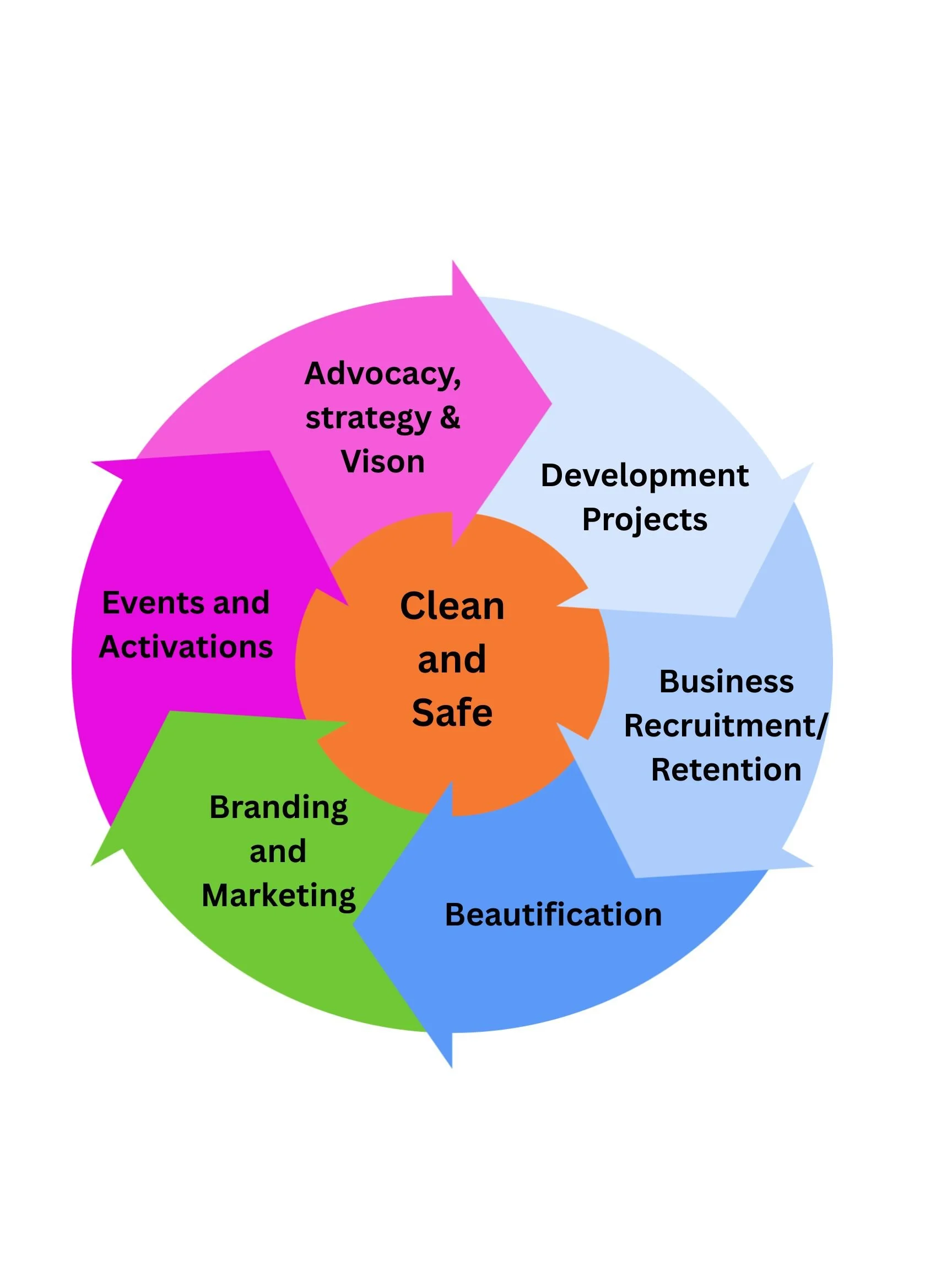
Differentiating between a hierarchy of outcomes (left) and an ecosystem of effort (right)
Districts are ecosystems. And like all healthy ecosystems, the relationships between these layers are far more circular — and symbiotic — than they appear.
Achieving a “safe” downtown is more often than not the result of an orchestra of efforts that include marketing, activation, recruitment, and sometimes — especially — advocacy.
A well-produced event brings hundreds or thousands of additional “eyes on the street,” increasing informal guardianship and normalizing positive use of space.
Thoughtful branding sets expectations about behavior and signals stewardship and care.
Beautification communicates investment and pride, which influences how people treat a place.
Business recruitment increases regular foot traffic and daily activity — which research consistently shows correlates with perceived safety.
And advocacy — whether for policy alignment, services, lighting improvements, or funding — often unlocks the very tools districts need to support public safety effectively.
When districts are formed, funded or renewed, priorities are often shaped by assumptions that mirror the adapted Maslow’s pyramid. The instinct is to invest primarily in Safety as an activity — uniforms, patrols, equipment — while underinvesting in the other layers that are essential in producing the outcome of safety.
Everything above that “foundation” is not sitting on safety
— it is actively reinforcing it.
It is completely reasonable to expect that the Clean and Safe line item represents the lion’s share of a district’s budget. It requires trained, talented, supported people — often a lot of them. Doing that right — and well — is and should be expensive.
But there has got to be room for additional approaches.
Not eventually, once the Clean and Safe goals are achieved. Not as a luxury add-on. Always.
Because everything above that “foundation” is not sitting on safety — it is actively reinforcing it.
The pyramid suggests sequence: first this, then that. In practice, districts function more like a loop.
Advocacy may appear at the top of the pyramid, but it is often what secures the resources to make Clean and Safe possible in the first place. Events may look secondary, but they can dramatically shift perceptions of safety overnight. Marketing may seem cosmetic, but it shapes narrative — and narrative shapes behavior.
Safety is not just a prerequisite for place. It is a byproduct of place working well.
Perhaps the better image is not a pyramid at all, but a circle — an ecosystem in which each layer supports and strengthens the others.
The question for districts is not simply: “Are we investing enough in safety?” It may be: “Are we investing in all the things that actually produce safety?”